

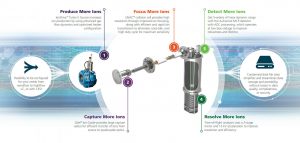
Stay ahead of the curve by using the most advanced and versatile high-resolution accurate mass technology. The TripleTOF® 6600 accurate mass QTOF system can help you to analyze your samples faster, without compromising between speed, resolution, and sensitivity. Explore the technological advances that give this system the performance edge.
- Produce More Ions: IonDrive™ Turbo V Source increases ion production by using enhanced gas flow dynamics and optimized heater configuration
- Capture More Ions: Qjet® Ion Guide provides large capture radius for efficient transfer of ions from source to quadrupole optics
- Focus More Ions: LINAC® collision cell provides high resolution through improved ion focusing, along with efficient and rapid ion transmission to eliminate cross-talk and high duty cycle for maximum sensitivity
- Detect More Ions: Get 5-orders of linear dynamic range with the 4-channel MCP detector with ADC processing, which operates at low bias voltage to improve robustness and lifetime
- Resolve More Ions: Time-of-flight analyzer uses a 2-stage mirror and 15 kV acceleration to improve resolution and efficiency
In addition, you can get the flexibility your lab needs by configuring with nanoflow, microflow, conventional flow LC, or with capillary electrophoresis spray ionization (CESI) separation systems. And condensed data file sizes simplify and streamlines data storage and portability, without losses in data quality, completeness, or security.


0 Comments