

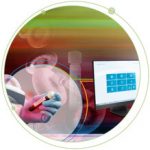
 Welcome to the first post in our clinical diagnostic blog series. Our ambition is to become your single destination for everything mass spec in the clinical diagnostic lab. To make this blog as useful as possible for you, we invite you to tell us what topics you would like us to cover. Please comment on this blog below and let us know what you’d like to hear!
By way of an introduction, we thought we should start by explaining “Mass Spectrometry Made Simple” – our guiding principle in mass spec innovation for clinical diagnostic labs.
Decades of Proven Innovation
You may already know this, but just in case, SCIEX is a global mass spec leader with a focus on the life sciences industry. For over 40 years we have helped thousands of laboratory analysts to find answers to the complex analytical challenges they face. Read more about our history >
The saying, “Mass Spectrometry Made Simple” reflects the future direction of SCIEX technology in the clinical diagnostic space. We pioneer mass spec solutions with usability as a leading design principle and are excited to introduce our newest solution at this month’s AACC conference.
The Mass Spec Revolution
Laboratory managers want mass spec for the accuracy, sensitivity, and specificity assays that cannot be achieved by traditional technology, such as immunoassay platforms. Although mass spec has been around for decades, its adoption has been limited due to the inherent complexities of operating the instrument.
Our clinical diagnostics team is determined to change this.
We want to make mass spec so simple that more laboratories can leverage this precision technology to do more, save more, and deliver more confident results. To this end, we are working with you to improve the usability of our mass spec instruments.
The Topaz™ System, Powered by ClearCore™ MD Software
Designed specifically for the clinical lab, the Topaz System delivers on our promise. It combines the robustness of an integrated SCIEX LC-MS/MS workhorse with the intuitive design of ClearCore MD Software—our pièce de résistance.
It has been developed with one thing in mind, to simplify adoption for new mass spec users and to enable users with varying levels of experience to master mass spec.
ClearCore MD Software is intuitive:
- Intuitive tile-based interface lets you do more with a single click
- Simplified menus within each module for faster, easier navigation
- Instrument status panel with visual indicator and status updates to maximize uptime
- Streamlined workflows and data processing to improve usability and throughput
- Ability to rapidly develop and deploy methods with simplified control
With SCIEX, you will bring the power of LC-MS/MS technology to the hands of the routine user.Contact me, I’d like to hear more >
Don’t forget to tell us what topics you would like to hear about in future blogs by commenting below. To comment, please log in to your account.
AB Sciex is doing business as SCIEX. © 2018 AB Sciex. For in vitro Diagnostic Use. Not available in all countries. The trademarks mentioned herein are the property of AB Sciex Pte. Ltd. or their respective owners. AB SCIEX™ is being used under license.


0 Comments