

 Answer: When it’s a QTRAP®
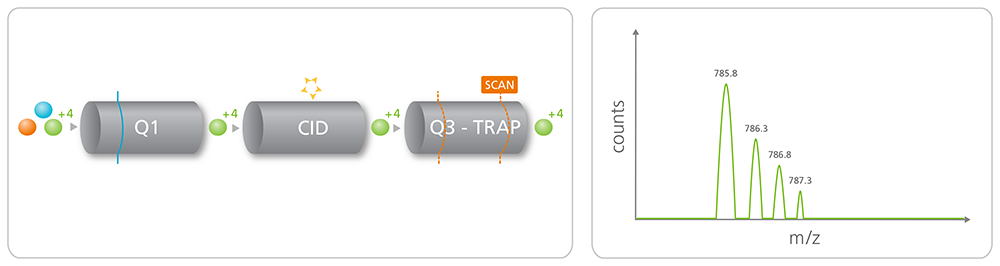
In today’s modern and frenzied analytical laboratories, triple quadrupole mass spectrometers (MS) are the ‘workhorse,’ frontline instrument for carrying out quantitative assays from drug discovery to food safety. To get the best selectivity and sensitivity for a particular compound under detection when performing quantitative assays, selected reaction monitoring (SRM)/ multiple reaction monitoring (MRM) is used as a data acquisition technique. The use of MRM allows hundreds of compounds to be analyzed during a single chromatographic separation. This is made possible due to the very specific way a compound is detected – precursor to product collision induced fragmentation and subsequent ion detection. Figure 1 below highlights a schematic representation of an MRM with a triple quad MS. Figure 2 shows how in a 20 min chromatographic runtime how you can detect over 250 compounds with extremely high specificity.
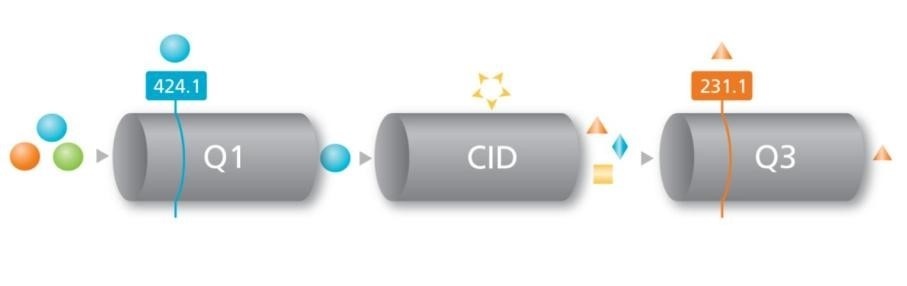
Figure 1. Precursor to Product Ion CID Fragmentation Producing Specific MRM for an Analyte of Interest
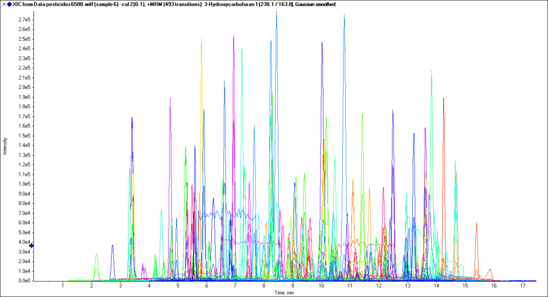
Figure 2. Analysis of ~250 Compounds (~500 MRM transitions) in a Single Assay
The benefit of MRM? Well – it provides the three S’s. Selectivity, Specificity and Sensitivity. The result is a high-performance way of analyzing and quantifying compounds in both simple and complex matrices.
But, what if you could go beyond just a standard triple quadrupole to do more with your analysis? Well – let’s introduce SCIEX QTRAP technology – looks like a triple quadrupole from the outside, but it’s no ordinary triple quadrupole under the covers.
The QTRAP system is based on the conventional ion path of a triple quadrupole mass spec. In contrast to conventional triple systems, however, the third quadrupole (Q3) of a QTRAP system can also be operated as a Linear Ion Trap (LIT). This dual functionality of Q3 provides the QTRAP system complete functionality as a triple quadrupole mass spectrometer but with additional powerful qualitative scan functions. These additional linear ion trap scan functions greatly enhance the performance and flexibility of the QTRAP system for applications such as screening, confirmation and identification applications. With a QTRAP system, all of the MRM sensitivity of a triple quadrupole is combined with a multi-functional ion trap with no compromises. Not only does this afford the highest performance for quantitative and qualitative experiments on the same instrument, it also enables new and powerful TripleTrap™ scanning workflows that combine triple quadrupole functionality with LIT functionality within the same experiment – making your laboratory more productive using ordinary triple quadrupoles.
So – need reasons why you should consider a QTRAP over just a standard triple quadrupole doing just MRM data acquisition? Look no further:
Challenging quantitative assays caused by interferences from complex matrices?
QTRAP technology can decrease the worry for accurate quantitation.
Selectivity can be increased beyond standard MRM as the integrated LIT enables unique MRM3 – highly specific quantitation from second-generation product ions, which decreases matrix interference and reduces the need to have more detailed sample prep. The schematic below highlights the MRM3 data acquisition function.

Concerned about the accuracy of your identification? Want to reduce false positives/negatives?
QTRAP technology can reduce the doubt with definitive compound identification
Enhanced Product Ion (EPI) functionality gives you complete full scan MS/MS spectra to cross-reference with an integrated library for ultimate confirmation when reporting your results.
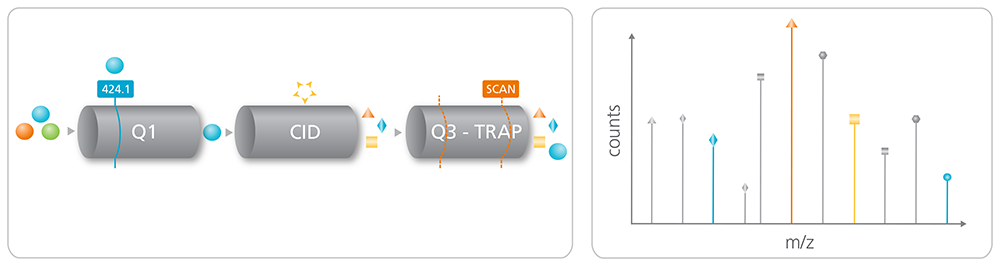
Looking to increase throughput by decreasing sample rechecks?
QTRAP technology produces more high-quality results in every run.
By capturing MRM and EPI MS/MS confirmation scans in one injection/one peak, you get high-quality MRM quantitation with MS/ MS spectra confirmation at once for ultimate throughput and fewer rechecks.
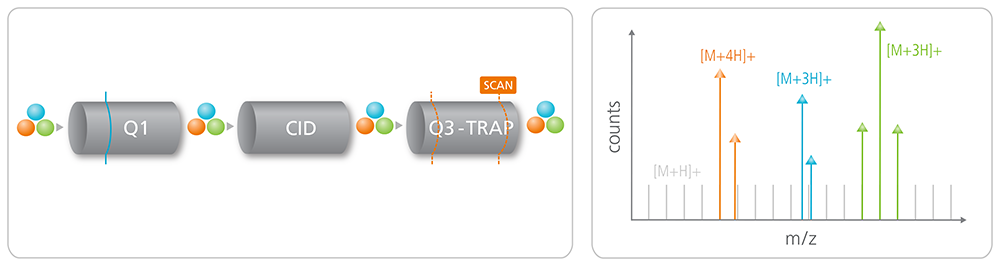
Needing to find unknowns in your samples?
QTRAP technology has the tools for your search.
With the Enhanced Mass Spec (EMS), Enhanced Resolution (ER) and EPI scanning capabilities, QTRAP can help you find and characterize components in your sample.
Being asked to do more than just quantitation?
QTRAP technology gives you diversity.
Enable your lab with functionality beyond triple quadrupole technology. Sensitive and robust MRM quantitation combines with multiple other unique enhanced scan functions, giving you the quantitative performance of a triple quadrupole system with added power to develop new methods or improve your existing workflows. Experience the power to do so much more on one mass spec system.
Need more convincing? Then look no further than at https://sciex.com/technology/qtrap-technology where you can learn more about QTRAP technology, the scan functions and how it can improve your LC-MS/MS assays for both quantitation and qualitative identification on a single platform.
QTRAP – no ordinary triple quadrupole MS.Learn more about the nearly 50 years of innovations of SCIEX mass spectrometry technology visit the Generation Quant Docu-Series >


0 Comments