

 If you work in the breakneck world of therapeutic development, then you probably don’t even have time to read this blog (but we thought we would write it anyways, just in case). Drug metabolism samples are coming into your lab fast and furious. You need to turn them around in hours so that chemists and biologists can optimize the effectiveness of the therapeutic candidate. Time for lunch? We don’t think so!
The chances are that you know about high-throughput LC-MS techniques, you probably even know that you need to adopt them, but where do you start? We know how demanding routine biotransformation studies can be, so we have done our best to make this as easy for you as possible with a solution that came from very clear objectives.
We wanted to help you maximize compound analysis while reducing method development time. We wanted to impress you with fast, automated data processing to identify the top metabolites and soft spots. We wanted to give you absolute confidence in the data report, and in a format that a medicinal chemist would like to see. We wanted to give you assurances in instrument uptime so you can just focus on getting the answers you need. We wanted you to have time for lunch!
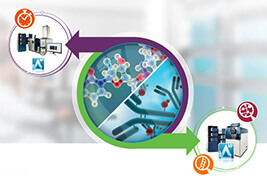
We bring you the Routine Biotransform Solution, a simple and streamlined platform for high-throughput MetID analyses for both small and large molecule therapeutics. The compact, easy-to-use instrumentation and powerful automated data processing software helps you achieve new levels of productivity and throughput to boost performance and keep your projects moving.
We have crammed in as much of our best-in-class LC-MS technology as we possibly can, making routine ID of the top metabolites and biotherapeutic catabolites as simple and fast as possible. Fully integrated into one complete solution, you benefit from:
- Streamlined Hardware: The X500 QTOF high-resolution, accurate-mass system is an easy-to-use, robust platform for accelerating your high-throughput metabolic stability and MetID studies.
- Simplified Set-Up: Save time and energy with the intuitive and user-friendly SCIEX OS user interface. Simplified set-up makes creating and running methods easy, even for non-mass spec experts.
- Robustness with Ultra-Low Downtime: The ExionLC™ AD delivers high accuracy, reliability, and repeatability across thousands of injections, with maximum uptime.
- Small Molecule Metabolism and Biologics Catabolism Data Analysis in the Same Package: MetabolitePilot™ Software 2.0 offers small molecule drug metabolite profiling and structure determination as well as the industry-leading solution for large molecule biologic catabolism analysis.
We know it is a lot to take in, but if you need high-throughput, then you need a solution as powerful as the Routine Biotransform Solution from SCIEX. For further information on how you can transform your biotransformation studies download the information pack today.


0 Comments