

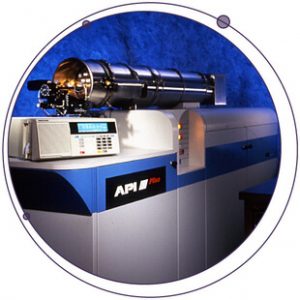
 Walk into any modern pharmaceutical company these days, and you’ll likely find at least one if not many, SCIEX LC-MS/MS instruments. Assays for the detection and quantitation of small molecule drugs, metabolites, biotherapeutics, biomarkers, and many other analytes using LC-MS/MS now constitute a major and indispensable workflow in pharma laboratories around the world. And it all started 30 years ago with the introduction of the SCIEX API III. As the world’s first commercially available atmospheric pressure ionization LC-MS/MS system, the API III revolutionized drug research and development and set a new precedent for the sensitive detection and quantitation of drugs and their metabolites from biological fluids.1,2
In fact, it was two fundamental SCIEX innovations in the source and interface designs that contributed to the rapid and widespread adoption of the API III. The IonSpray™ source consisted of electrospray technology but with the addition of a nebulizing gas to assist with breaking up and drying of liquid droplets. The Curtain Gas™ interface combined a larger orifice opening and faster pumping with a barrier of dry gas in front of the orifice to reduce clustering and clogging and prevent solvent vapors and particles from reaching the orifice.3 Together these innovations increased the efficiency of ion desolvation and overall sensitivity and ruggedness of the system and allowed the routine connection of LC effluents directly to the mass spectrometer.
The API III transformed bioanalysis as we know it, and since that time, the demand to create LC-MS/MS instruments with ever-increasing sensitivity has been a constant drumbeat within the pharmaceutical community. With higher sensitivity, lower concentrations of drugs can be analyzed, low-level metabolites can be detected, compounds can be more easily discerned from within matrix background, and sample preparation becomes simpler. To answer that call SCIEX has never stopped evolving every component of its mass spectrometry technology, with sensitivity improvements at the heart of many of these innovations. Leaving no component untouched, these innovations have come from everywhere; from the source to the detector; from the interface to the collision cell; from the pumping system to the software. But sensitivity improvements must be accomplished without sacrificing other performance parameters such as accuracy, reproducibility, dynamic range, speed, throughput, and robustness. Today, the sensitivity of SCIEX instruments has increased by many orders of magnitude from that first API III platform while simultaneously improving all other aspects of performance as well.
For example, the current Optiflow® and Turbo V™ sources were born from a lineage that harks all the way back to the original IonSpray source concept. Adding heat, changing spray orientation, and optimizing electrodes became the basis of the highly sensitive yet rugged plug-and-play designs in use today that can handle a wide range of flow rates and sample types. Today, the Turbo V source design is renowned around the world for its efficiency and productivity and is, in fact, the inspiration for many versions of the technology widely adopted in the industry.
But the ion source isn’t the only component where sensitivity gains can be realized. Once ions are generated, they need to be moved into the high vacuum region of the mass spectrometer, analyzed, and detected. With the development of QJet® ion guide technology (an RF-only quadrupole used for ion compression at high pressure), more ions could be efficiently captured and transmitted into the instrument. Along the ion rail, the innovative LINAC® collision cell (LINear ACcelerator) allowed the acceleration of ions through the collision cell, thereby increasing sensitivity and accuracy, and allowing hundreds of compounds to be analyzed in a single analysis without cross-talk. And with the development of the IonDrive™ High Energy Detector, a larger detector area and higher energy dynode have enabled analytes across a wide scope of chemistries and masses to be detected and quantified with up to 6 orders of linear dynamic range in either positive or negative polarity.
Software innovations have been plentiful as well. Advanced peak finding algorithms both within data acquisition as well as data processing, continue to enhance and improve sensitivity with the capability to find peaks buried within complex spectra and chromatograms. The development of the Scheduled MRM™ Pro Algorithm enabled far greater numbers of MRM transitions to be monitored within a single analysis, thus not only vastly improving throughput but also sensitivity for samples in complex matrices.
These are just some of the many advances that have contributed to sensitivity gains. From the introduction of the API III in 1989 to the more recently introduced SCIEX Triple Quad™ 6500+ LC-MS/MS system of today, SCIEX has never stopped researching and developing its LC-MS/MS technology. Today’s instruments provide the lowest limits of quantitation (LLOQ) for compounds of many classes, even in complex matrices. But we’re never satisfied. Innovations continue to this day. And you can be sure sensitivity improvements will always be at the heart of SCIEX research.
References
- The fascinating history of the development of LC-MS; a personal perspective, Frank Pullen, Chromatography Today, February/March 2010, https://www.chromatographytoday.com/article/hplc-uhplc/31/unassigned-independant-article/the-fascinating-history-of-the-development-of-lc-ms-a-personal-perspective/601
- Development of bioanalysis: a short history, Howard Hill, Bioanalysis, Vol. 1, No. 1, 27 Mar 2009, https://doi.org/10.4155/bio.09.3
- Ion spray interface for combined liquid chromatography/atmospheric pressure ionization mass spectrometry, Andries P. Bruins, Thomas R. Covey, and Jack D. Henion, Analytical Chemistry 1987 59 (22), 2642-2646


0 Comments