

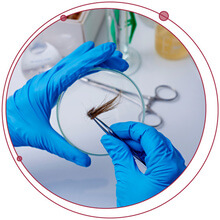
 Do you want a more efficient workflow for the forensic analysis of THC-COOH in hair samples? Yes! Do we know a simple, highly sensitive technique? You bet! Read on to find out how you can detect THC-COOH in hair down to 0.2 pg/mg trace concentration levels with excellent accuracy (>95%) and precision (<15%).
Marijuana is the most widely used recreational drug in the world, with reported users as high as 234.1 million worldwide. Forensic toxicology labs face the task of testing hundreds of thousands of samples every year to identify drug misuse in relation to a range of civil and criminal investigations, such as intoxicated driving investigations, child custody cases, sexual assault cases, and parole abstinence monitoring.
The presence of the main marijuana metabolite – THC-COOH – can be detected in urine, blood, and saliva and indicate active drug use. While these biological fluids are valuable in determining use in the short term, hair testing offers an advantage due to its larger detection window. Consequently, for accurate detection of long-term cannabis use (up to 90 days), hair samples are far more reliable sources and are widely accepted in criminal and civil courts.
However, using hair for detecting cannabis does provide its own analytical challenges. Firstly, the concentration of THC-COOH in hair samples is characteristically low, and secondly, there is a high abundance of matrix interferences that specifically impact the detection of THC-COOH.
Efficient Workflow. Sensitive Detection. Accurate Results.
As you probably know, our team love an analytical challenge; things around here wouldn’t be the same without them! And so, we have pleasure in presenting an efficiently designed analysis approach that gives accurate results. Our workflow combines the TripleQuad™ 4500 LC-MS/MS System with a solid phase extraction procedure that allows the reliable and sensitive detection of THC-COOH at trace levels (0.2 pg/mg) in hair matrix.
Find the complete technote, ‘Efficiently Designed Workflows Provide Accurate Results in Forensic Analysis of THC-COOH in Hair Samples’ in our Forensics Compendium, fill out the form on your right to download it today.
Without giving too much away in this blog, we wanted to share the top three highlights:
- Benefit from an efficient 6-step extraction protocol using Strong Anion Exchange (SAX) Solid Phase Extraction to remove complex matrix interferences. This can be rapidly implemented and optimized for selective analysis of THC-COOH in hair.
- SCIEX TripleQuad 4500 LC-MS/MS Systems feature high analyte recovery for stable and sensitive performance from Turbo V™ source; ultra-fast MRM cycle times to increase sample throughput and data quality; and up to 5 orders of dynamic range for high-performance quantitation, reducing the need for repeat analysis.
- Achieve fast quantitation thanks to powerful MultiQuant™ Software 3.0, delivering streamlined and accurate data processing of trace level concentrations of THC-COOH. With less manual intervention you can release more accurate results, faster.
This workflow for the forensic analysis of THC-COOH in hair samples is ready to be integrated into your forensic toxicology laboratory. You will experience more accurate results with a more efficient workflow designed to support optimum throughput and sensitivity.
To find out more download the full technote, by filling out the form on your right, today.


0 Comments