

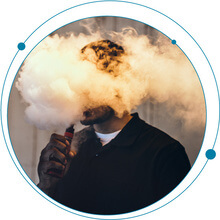
 The safety of vaping has recently become a topic of concern. The public wants answers about the safety of these products. Health authorities are scrambling to find the cause of the mysterious vaping illness that has been seen in hundreds of cases across the U.S., and that has caused multiple deaths.
Current news highlights related to recent cases:
- There have been 11 vaping-related confirmed deaths as of Sept 26
- The U.S Center for Disease Control and Prevention (CDC) reported vaping-related illness had sickened 530 people but NBC News reports there are more than 1000 cases of the illness being investigated across the U.S
- The Trump Administration plans to ban flavored e-cigarettes
- This week, the state of Massachusetts became the first state to temporarily ban the sale of all vaping products and devices. This follows the flavored e-cigarettes ban last week by New York and Michigan state
- Hawaii has banned unregulated cannabidiol (CBD) products
- India has completely banned e-cigarettes
- U.S. Food and Drug Administration (FDA) identified vitamin E acetate as a common contaminant in marijuana vaping product used by many of the sick patients
- The vaping illness outbreak has affected both cannabis and nicotine products
- The world’s largest retailer, Walmart, will stop selling e-cigarettes
Vaping has been around for years. It is too soon to know whether the recent cases are a new type of outbreak or something common that is just being seen through a lens of heightened awareness. The question remains: What is causing this illness?
Is investigating vitamin E acetate or polyethylene glycol the right focus? What about the questions surrounding the use of tetrahydrocannabinol (THC) as an ingredient in these e-cigarettes? Is mixing THC and nicotine to blame? The search for answers continues.
It makes sense to look at how an outbreak like this could happen. How could something unsafe make it into vaping products? One possible contributor to the situation is the lack of regulations around ingredients in both tobacco and cannabis vaping products. There is little transparency around ingredient labeling and few restrictions on additives. In an effort to further protect children, the FDA has announced plans to ban all non-tobacco e-cigarettes.
Another piece of the puzzle is the increase in counterfeit and illegal vaping products that have infected the market. Products are tampered with and adulterated, without consideration for the user’s safety. For instance, Wisconsin police reported a drug operation that was filling 3000-5000 illegal THC-infused vape cartridges a day for 2 years! Also, extremely concerning is that the THC potency of these products was 157 times higher than indicated on the labels. Imagine someone purchasing a vape pen from what they assume is a safe and reputable vendor (who follows strict testing protocols) only to find that it’s laced with synthetic cannabinoids, or worse, fentanyl.
Other states may soon follow Hawaii’s lead in regulating CBD products, now that the risk of vaping illness is very real. This might also impact CBD-infused drinks found on shelves in established institutions—due to a lack of testing to demonstrate product safety. It will be interesting to see how regulations evolve. Will the rest of the world follow India and ban e-cigarettes entirely, too?
As analytical scientists, we want to understand what about the vaping chemistry is causing injury. Is it a single toxic compound, or a mixture of substances? Is there a mechanism or trace-level compound that we’re not examining?
Stay tuned for part 2 of this piece where we discuss vaping chemistry and share what we found when we tested several commercial vape products.
As of the writing of this article, these were the most up to date facts and figures.


0 Comments