


Would you like to take your LC-MS/MS analysis from 0 to 3 mL/min without the complexity of changing probes or splitting the LC flow? Then take a look into the Turbo V ion source from SCIEX.
Introduced more than 15 years ago, the Turbo V ion source continues to be a gold standard for rugged and user-friendly source design, for both ESI and APCI ionization. This shrewd architecture provides outstanding robustness and sensitivity when analyzing complex biological matrices with minimal maintenance. By merging two orthogonal streams of hot gas in the ESI region, efficient desolvation and hydrodynamic focusing of ions towards the sampling orifice is achieved.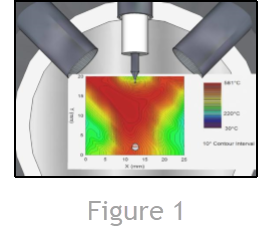
For higher flow rate applications, this can translate to boosts in sensitivity of several orders of magnitude over unheated ESI sources. Desolvation is greatly improved without disrupting the curtain gas flow and greatly boosts the robustness of the entire system. Figure 1 schematically represents the heated gas flows within the Turbo V source.
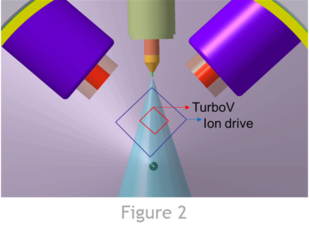
The success of the Turbo V ion source over the years served as the inspiration and foundation upon which the more recently introduced IonDrive Turbo V and OptiFlow Turbo V ion sources are designed. Each of these sources benefits from the use of orthogonally placed jets of heated gas directed at the liquid sample spray to enable even more efficiency of desolvation at different liquid flow regimes. While robustness and ruggedness were built in from the start, plug-and-play simplicity and a “just put it on, and it works” engineering is typical of all present-day SCIEX sources based on the Turbo V. Figure 2 highlights the wider heaters involved with the IonDrive Turbo V design for increased desolvation and thus higher sensitivity. The red square indicates the ‘sweet spot’ of standard Turbo V and the blue square highlights the bigger ‘sweet spot’ of IonDrive.
Key benefits of the IonDrive Turbo V Source
- High sensitivity for any matrix with enhanced ionization efficiency
- Sensitivity is gained from hydrodynamic focusing of ESI droplets with a wider heater sweet spot in the Turbo V IonDrive source
- Extraordinary robustness in performance providing higher productivity
- The simple source architecture and orthogonal spray design with no complex spray path provide uniform temperature distribution and optimized curtain gas flow to improve robustness and ruggedness
- High throughput analysis over a wide range of flow rates
- With functional flow rate ranges from 5 µl/min to 3 mL/min, the IonDrive Turbo V source is the perfect match for both micro flow HPLC applications with new low dispersion electrodes and analytical flow UHPLC flow rates, delivering unmatched desolvation and stability for the most demanding applications
- Wider compound class coverage
- The ability to quickly interchange ionization modes between APCI and ESI enables wider compound class coverage and easy and faster method development
- Simple plug and play ion source design
- A tool-free source design enables plug-and-play capability with almost zero maintenance
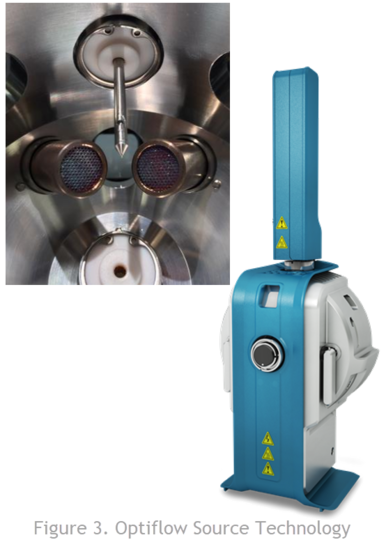
The recent introduction of OptiFlow technology allows the use of the Turbo V design to be translated to lower flow rate chromatography, such as nano and micro-flow rates. The benefit of lower flows can help with gains in sensitivity especially when you are ‘sample limited’. Significant research was done to develop a low-flow source that is sensitive while maintaining high robustness and ease of use of higher-flow sources. The result is an ion source, based on the legendary Turbo V design, with the ability to switch easily between nano and microflow regimes. No need to change the source, break vacuum and the system can be back up and running in minutes. Simple, robust and reliable. Figure 3 shows a picture of the Optiflow ion source based on the Turbo V geometry. Learn more about the legendary Turbo V ion source >
To see more about the 50 years of SCIEX mass spectrometry technology innovations visit the Generation Quant docu-series.


0 Comments