

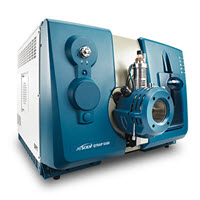
 Recent regulations on food analysis require screening for pesticides using confirmatory techniques, such as GC-MS and LC-MS/MS. More than 1000 pesticides are used worldwide and, along with their metabolites and degradation products, are present in food. There is a demand for powerful and rapid analytical methods that can identify pesticides with high confidence in a broad range of food matrices and quantify at low concentrations with good accuracy and reproducibility. Challenges for pesticide residue laboratories at the moment are the request to test for more compounds, in a wider range of samples, all without sacrificing data quality. The QTRAP® 6500 LC-MS/MS system uses multi-component IonDrive™ technology to:
- Improve ionization efficiency using the new IonDrive Turbo V ion source
- Increase robustness using a re-engineered curtain gas interface acting as a better barrier against neutrals and microdroplets
- Increase sensitivity using the new IonDrive QJet ion guide with dual stage design
- Extend the linear dynamic range for quantitation using the HED IonDrive™ detector
In addition, the QTRAP 6500 system uses the patented and proven Linear Accelerator™ trap technology to:
- Acquire full scan MS and MS/MS spectra with high selectivity sensitivity, and speed
A new method for the quantitation and identification of hundreds of pesticides in food samples was developed and successfully applied to the analysis of complex food samples using the QTRAP 6500 system. Results are compared to QTRAP 5500 data. The increased sensitivity was used to extensively dilute sample extracts to eliminate ion suppression caused by matrix components and the extended linear dynamic range allowed quantifying more pesticides across a wider range of chemical properties. QTRAP scanning was used to investigate the presence of matrix components and to identify targets with high confidence through library searching. Quantitative and qualitative results were generated using MultiQuant™ and LibraryView™ Software.
See the results in the full article by downloading the Food Compendium.


0 Comments