

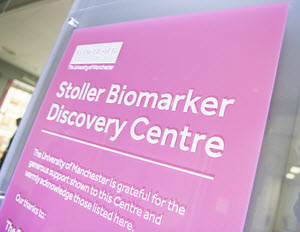
 The Stoller Biomarker Discovery Center, developed in partnership with SCIEX, was created to develop new omics technologies for biomarker research to understand the root cause of diseases such as cancer, cardiovascular disease, and autoimmune diseases. We initially announced our collaboration with the University of Manchester back in October 2015.
 The Centre was officially opened at an event attended by Professor Dame Nancy Rothwell, President and Vice-Chancellor of The University of Manchester, Sir Norman Stoller and trustees of the Stoller Charitable Trust, Dan Daniel, Executive Vice President of Danaher and Jean-Paul MangeollePresident of SCIEX, with a ceremony during the Stoller Biomarker Discovery Centre Symposium. The event featured leading speakers from around the globe who shared their latest research on biomarker discovery and development, and included pioneers within the proteomics field such as Dr. Leroy Hood, Dr. Leigh Anderson, and Professor Jennifer Van Eyk.
Professor Rothwell said: “Manchester has become a major hub for precision medicine and proteomics and we are very grateful to the funders who have backed the cutting-edge work that is carried out by our scientists.”
“As a result of their generosity, The Stoller Biomarker Discovery Centre will start work on addressing some of the biggest issues in medicine in an environment where these discoveries can move quickly into utilization to improve people’s lives.”
 The Stoller Biomarker Centre is located at CityLabs Manchester, a growing biomedical science hub, and adjacent to the Central Manchester University Hospitals, National Health Service (NHS) Foundation Trust and The University of Manchester. The new Centre houses a large suite of high-end SCIEX mass spectrometers for targeted next-generation proteomics, including TripleTOF® 6600 Systems for SWATH® Acquisition, QTRAP® 6500+ Systems, and the SCIEX Lipidyzer™ Platform. The University of Manchester has also invested in SCIEX nanoLC™ 400 liquid chromatography systems and automated sample preparation components (Beckman Coulter’s Biomek NXP Laboratory Automated Workstation) for the Centre.
“SCIEX mission of innovating integrated, reliable analytical tools to enable scientific discoveries that ultimately lead to better health care, enables our customers to advance precision medicine with scale and speed like never before,” states Jean-Paul Mangeolle, President of SCIEX. “And it takes more than providing great instruments to be part of a movement as important as Precision Medicine; it takes strong collaborations with researchers, partnerships with industry leaders and teamwork with our colleagues at other Danaher Life Science companies, to establish and deploy the most comprehensive proteomics solutions.”


0 Comments