

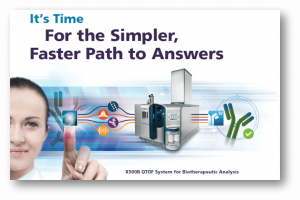
 Have you ever wished for a compact instrument that delivers expert-level answers to your most complex biotherapeutic characterization challenges faster and easier than what you are doing now? At SCIEX, we recognize that even expert users want easier ways to perform daily characterization tasks and get great results every time. That’s why we set out to develop the X500B QTOF system: a robust and reliable new instrument and software solution that reduces complexity and simplifies biologics characterization workflows so every scientist can get expert-level results.Download Info Pack >
Flexible and Robust: The X500B QTOF Makes Standard Characterization Workflows a Breeze
The new X500B QTOF system is the first true benchtop, high-resolution mass spectrometer designed specifically for characterization of complex biologics, delivering high-quality data for intact mass and peptide mapping analyses–including post-translational modification identification–and characterization of antibody-drug conjugates. The system utilizes the renowned SCIEX Turbo V™ ionization source and a heated TOF path for maximum robustness and reproducibility. Add to that the new SCIEX OS Operating System and BioPharmaView™ data processing software, which are surprisingly easy to learn and operate.
The new X500B system enables you to:
- Automate standardized methods and data analysis tasks, making daily biotherapeutic characterization accessible to any scientist
- Spend more time focusing on meeting your deadlines, with powerful data analysis tools to visualize and compare results across biotherapeutic samples
- Maximize productivity and minimize downtime for training and maintenance in your lab
As a part of the SCIEX 360º Innovation for Biologics Characterization strategy, the X500B QTOF system is designed to help you get better answers, faster. For standard biologics characterization workflows, the compact X500B system is the next “big” thing to improve your lab’s productivity and throughput.
- Solution guides for peptide mapping, intact mass, and comparability analyses
- Method flyers for biologics characterization
- Lab Director brief on the value of simplified workflows


0 Comments