

 Down Syndrome Metabolomic Research
SCIEX Academic Partnership Program (APP)
by Olivia and Christina Iverson
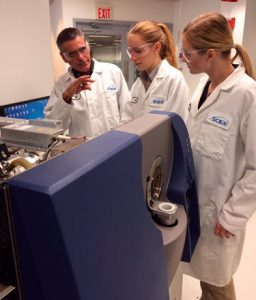
Last week we launched a really interesting research project with Jeff Miller, Senior SCIEX Scientist, using a SCIEX QTRAP® 6500 mass spectrometer. Our plan was to test whether acetaminophen is metabolized differently in people with Down Syndrome (our younger brother William has Down Syndrome).
We began by taking 20mg/kg (body weight) of acetaminophen after fasting all night. We then took saliva samples at the intervals of 30 minutes, 1, 2, 3, 4, 6, 8, and 10 hours. We all ate exactly the same food throughout the day (whenever William stole a cookie we had to eat exactly the same thing) and our saliva samples were kept in our home refrigerator overnight.
We prepared the samples in the SCIEX Boston demo lab the following day. This preparation involved diluting the saliva in acetonitrile to remove proteins—a process we learned was called “crashing” the sample. We then dried down the samples. We also created a standard curve to which the saliva samples would be compared in the mass spectrometer. These tasks took almost a full day. Mr. Miller mentored and helped us throughout the lab work, as we had never done something like this before.
Working in the SCIEX lab with Mr. Miller was a really great experience. We learned a lot about how a real lab functions. The saliva sample prep took a while, but it was still really fun (I’m sure that if we became professional scientists we might learn to dislike sample prep, but it was still exciting). We also learned that professional labs are safer, cleaner, and more efficient (and full of more great equipment) than the lab at our high school!
We had to create a “method” to process our sample data on the mass spectrometer, and a lot of time was spent running tests and tweaking the method. Our comparative standard curve was run first, and we quickly realized that the amount of acetaminophen in the saliva that we used to create this curve was too high (when we spit into the vials to create the standard curve 24 hours after dosing we still had acetaminophen in our system). Because of this, we had to completely redo the sample prep!
Additionally, the column on the mass spectrometer plugged (twice) because there was too much protein in our samples. Evidently, we hadn’t “crashed” them with enough acetonitrile. We had to re-prepare new samples from saliva that we had saved in the freezer. This took another day! Another scientist working in the SCIEX demo lab told us that we were getting the full science lab experience, complete with setbacks and errors!
We’re now ready to try again on the mass spectrometer. Tune in next week when we get some time on the QTRAP 6500 with Mr. Miller and we’ll share with you our initial results.
Update: We finally posted our first set of results — please see our next blog entry!
Excerpts from APP Interview with Rebecca Monk, SCIEX Scientist and Community Manager
Rebecca: Any big Ah-Ha! moments after working in the SCIEX lab for three days?
Christina: “I was surprised at how sensitive our experiment was. One mistake in the lab could completely ruin our data. I was also surprised how long it takes to get results — the effort occasionally involved a lot of repetitive work (pipetting chemicals into vials, etc.). Our project took a lot of focus, and I was surprised at how easily the scientists are able to do ratios in their heads to dilute and substitute the chemicals in the samples and standards. It was hard work.“
Rebecca: How has your impression of being a scientist changed as a result of doing this research at SCIEX?
Olivia: “A good scientist isn’t just someone who’s super smart and knows a lot about science –they’re someone who is able to combine these characteristics with good craftsmanship and detailed work. I was very surprised at how multidisciplinary the lab work actually is. You need to be really adept at using the computer programs that run the scientific instruments. You also need to be able to work with a lot of data both visually and numerically. As we went through the procedures I became very aware of just how meticulous and certain you must be to ensure accuracy.”
Rebecca: What are your thoughts about women working in science after your experience in the SCIEX lab?
Olivia: “So far I haven’t really seen anything that’s surprised me. Women can definitely be scientists! I guess my experiences in the SCIEX lab have just reinforced the fact that the stereotypical image of the pretentious, socially awkward scientist or engineer is a big fallacy. Everyone here has been very outgoing and friendly, and it seems like a really fun place to work. I’ve also worked in a hospital before and the labs there also seemed really open and fun, everybody chatting, etc.”
To read more about our experiences in the lab with Dr. Jeff Miller, please see our previous blog entry.


0 Comments