Search
Page 29 of 61
How do I calibrate my retention times when I plan to process my proteomics data with OneOmics suite?
If the retention times (RT) within the ion library to be used differ from the retention times that will be observed in the SWATH acquisition data to be processed, it is important to recalibrate the retention times within the ion library. If a Retention Time Calibration Protein already exists within your selected ion library, select […]
- Data processing
- Life Science Research
- OneOmics
- Proteomics
- QTOF
- SCIEX information
- ZenoTOF 7600 system
August 7, 2021
How is the protein level fold-change computed on proteomics data using Assembler app?
With bottom-up proteomics, we quantify peptides in the sample and then infer the protein level quantitation from that data. However, due to post-translational modifications, different protein isoforms, etc. we don’t always expect that all peptides associated with the same protein will exhibit the same behavior. The algorithm in the Assembler app incorporates this complexity of […]

Tags: confidence, fold change, protein, ratio
How do I define the experimental design (the metadata) for my SWATH acquisition study within the OneOmics suite? What are the requirement for replicates?
In quantitative Omics research, the goal is to understand which analytes (protein or metabolite) are perturbed between experimental conditions; therefore we carefully design our studies to explore these questions. The algorithms used within the Assembler application require this study design information to correctly compute the differences. Typically you will have 3 main classifications for the […]

- Data processing
- Life Science Research
- Metabolomics
- OneOmics
- Proteomics
- QTOF
- SCIEX information
- ZenoTOF 7600 system
Tags: biological, check, condition, design, experimental, form, group, information, job, machine, number, recommend, replicate, research, sample, science, study, study design, technical, work
What is the Most likely ratio normalization strategy?
When performing LC-MS quantitation, there are numerous sources of experimental variance that can confound the quality of your results (variation in the starting amount of sample, variation in the LC-MS measurements, etc.). Having a robust normalization strategy that can be applied to minimize the differences due to experimental artifacts between samples can provide an improvement […]
- Algorithms
- Life Science Research
- MarkerView
- Metabolomics
- OneOmics
- Proteomics
- QTOF
- SCIEX information
- ZenoTOF 7600 system
Tags: compute, experimental, factor, group, ratio, replicate, sample
What is the difference between the gobal and the local FDR rates in ProteinPilot software?
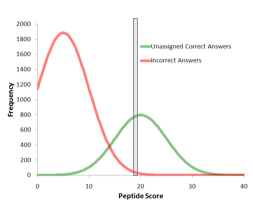
The main idea of the target-decoy approach to compute false discovery rates is to feed the search engine answers that you know are wrong. These are referred to as ‘decoys’, typically generated by reversing, randomizing, or scrambling real protein sequences. You then estimate error rates in your resulting answer list by seeing how these known […]
- Data processing
- Life Science Research
- ProteinPilot
- Proteomics
- QTOF
- SCIEX information
- ZenoTOF 7600 system
August 6, 2021
Protein alignment template for results comparisons across multiple group files from ProteinPilot software database searches
The key challenge in aligning protein level results is flexible matching by making use of the accession ambiguity in reported protein groups. The better this task is done, the more complete will be the protein matching across multiple results. For quantitative work, a high degree of protein matching translates to a low degree of incomplete […]

How do I use the new ProteinPilot software reports (small vs large)?
At the end of a database search, the software will write information into the ProteinPilot Report automatically. The ProteinPilotReport.xlsx file must be placed in the following directory for the automatic creation to work. C:\Program Files\AB SCIEX\ProteinPilot\WorkflowDirectory There are two forms of the ProteinPilotReport.xlsx, a light version and a full version. Switch between the two reports […]

Downloading and viewing ProteinPilot app group files on your desktop and extracting key exports
After the database search in OneOmics suite, the ProteinPilot software group file can be downloaded for viewing in your desktop ProteinPilot software 5.0.3. Please note that this is a beta version of ProteinPilot software, and as such is unsupported and provided as-is specifically for the purpose of viewing group files from OneOmics suite. Once downloaded, […]

Learn about the underlying results files created during processing, for use in other types of analysis
Intermediate files are generated and stored in your project folder at multiple processing steps. These files can be downloaded and opened for use in other tools or for applying to other types of analyses. View the community post on how to download files from either SCIEX Data Store or from BaseSpace. An overview of some […]

Downloading results from SCIEX Data Store or BaseSpace
Once your data processing sessions have completed, the results files are saved back to either SCIEX Data Store or BaseSpace. These can be downloaded from the cloud to your desktop for additional analysis. Please see these community posts to learn more: Explaining the underlying results files created during Extractor and Assembler processing Viewing ProteinPilot software […]
Tags: analysis, business, company, computer, data, desktop, download, file, folder, information, job, knowledge, management, name, result, result file, select, store, study, work
Page 29 of 61