Search
Page 31 of 61
What is principal component variable grouping (PCVG) and how do I use it?
In our previous post we discussed how to interpret the Scores and Loadings Plots produced by PCA. In many cases there are several dimensions that are found to have substantial influence over a specific principal component, and these dimensions are often correlated in their abundance in the sample population data. To help make sense of […]
August 6, 2021
How do I interpret the output from PCA?
Principal component analysis (PCA) is a data transformation technique that can be used to reduce the complexity of high-dimensional data sets (such as mass spectrometry data) while grouping samples based on common features. REMINDER! Principal components are linear combinations of the original dimensions (variables) that account for variance in the data. Principal component scores […]
What is principal component analysis and how does it work?
When we measure anything, the resulting measurements are often referred to as variables or dimensions. For example, a cube has three dimensions that can be measured: length, width and height. When we measure a complex sample using mass spectrometry (like a proteome, metabolome or food sample), we measure the molecules as mass features at specific […]
Peptide grouping in ProteinPilot software 5.0
A new feature in ProteinPilot software 5.0 is the ability to do peptide grouping. When analyzing proteomics data from LC-MS/MS, one must take into account the multiple pieces of evidence supporting a peptide as well as any ambiguity that might still exist in the peptide identification. Here, we think of a peptide group as a […]

- Data Visualization
- Life Science Research
- ProteinPilot
- Proteomics
- QTOF
- SCIEX information
- ZenoTOF 7600 system
August 5, 2021
How does ProteinPilot software obtain the annotations during a database search?
With the newest ProteinPilot software 5.0, we can annotate the database search results with ontology information about each protein using the information available from the UniProt website. After the final list of proteins is assembled during the search, the software will ping the UniProt website and pull back the information to populate the group file. […]

Quickly compare identification results from ProteinPilot software
When a ProteinPilot Software search is complete, a ProteinPilot report is generated that contains all the false discovery rate (FDR) analysis information. More information on using the large and small ProteinPilot reports can be found here When doing method optimization, you often want to review data across a set of experiments/search results to investigate whether […]

- Data Visualization
- Life Science Research
- ProteinPilot
- Proteomics
- QTOF
- SCIEX information
- ZenoTOF 7600 system
Tags: allow, analysis, computer, data, form, generate, information, input, item, knowledge, report, research, result, science, search, set, tab, tool, user, work
Using ProteoWizard for converting files – for use in ProteinPilot software
ProteoWizard is a set of open-source tools and libraries for proteomics researchers and includes file conversion tools that allow vendor-specific file formats to be converted to standard formats (mgf, mzML, mzXML and mzData). Learn how to download and install ProteoWizard here: http://proteowizard.sourceforge.net/projects.html Convert TripleTOF system *.wiff files to mzML Recommended settings for converting TripleTOF system […]
CloudTalk – CloudConnect and Experiment Manager for metabolomics
This Cloud Talk (7:44 min) describes how to upload data files to the SCIEX Cloud and organize them in Experiment Manager for metabolomics SWATH acquisition data processing

Computing protein confidence with improved accuracy by reassessing peptide confidence during protein grouping
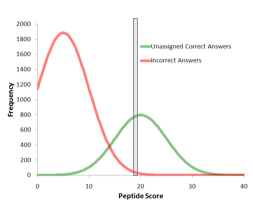
ProteinPilot software 4.0 and higher releases include a new method for calculating protein confidences that improves reliability at the end of protein lists. Figure 1 shows a simulated example that demonstrates how more accurate protein confidence is computed. Figure 1. This example simulation describes how more accurate protein confidence is computed. Other protein confidence calculations […]
- Data processing
- Life Science Research
- ProteinPilot
- Proteomics
- QTOF
- SCIEX information
- ZenoTOF 7600 system
Tags: art, assigned, bin, book, confidence, correct, figure, first, group, identification, model, money, number, object, protein, remaining, software, time, value, work
Unused Prot Score in ProteinPilot software
There are 2 key protein scores that are computed in ProteinPilot™ Software: Total ProtScore and Unused ProtScore. Total ProtScore is simply a sum of all the peptide evidence related to a given protein, while Unused ProtScore reflects the amount of total, unique peptide evidence related to a given protein. Because proteins can share homology (similarity […]
Page 31 of 61